Quick answer
"Cat 6e" is not a real standard. The recognized twisted-pair categories are Cat5e, Cat6, and Cat6a, under ANSI/TIA-568. We bought five 10-ft cables sold as "Cat6," measured each with calipers, a scale, and a microscope, and found two genuine bare copper, one acceptable, and two undersized copper-clad aluminum (one of them advertised as "Cat 6e"). Kestner builds cable to the stated gauge and bare-copper conductor, and measures it before it ships. Here is what the numbers showed, and how to check yours.
The short version
- "Cat 6e" is a marketing label with no ANSI/TIA-568 definition — the real ladder is Cat5e, Cat6, Cat6a.
- Genuine Cat6 uses about 23 AWG bare copper (24-26 stranded in a patch cord); two of our five ran 32-34 AWG — thinner than even their own stated gauge.
- Two cables showed the signatures of copper-clad aluminum (CCA) — lighter, more brittle, and a Power-over-Ethernet risk.
- The cross-section separates them: genuine Cat6 is round with a center spline and twisted pairs; both failures were flat, untwisted, and spline-less.
- A "UL" stamp is not automatically a Cat6 pass — read which mark it is. Read the jacket for the AWG, the UL file, and the TIA standard.
We bought five 10-ft Ethernet cables sold as “Cat6” — one of them badged “Cat 6e” — and measured every one with calipers, a 0.01 g scale, and a USB microscope, and cut them all open. Two were genuine bare copper. One was thin but fairly described. Two, both flat cables, were not Cat6 at all: undersized conductors, no certification on the jacket, a construction that cannot hold the spec, and claims the cable itself did not support. This is the whole test, with the numbers, and how to run the same checks on a cable in front of you in under a minute. For the categories themselves — Cat5e through Cat8 — see the Ethernet cable types guide. Brands are anonymized as Sample A–E; the point is the pattern, not naming a seller.
”Cat 6e” is not a real standard
Start with the label, because it is the first tell. The twisted-pair categories defined by ANSI/TIA-568 are Cat5e, Cat6, Cat6a, and Cat8. There is no Cat6e. It is a marketing suffix that borrows the credibility of Cat6a without meeting anything, and a listing that leans on it has already told you the seller is selling a word, not a spec. One of our five samples was advertised as “Cat 6e” at 32 AWG and 5 Gbps — and its own jacket, underneath the listing, simply read “CAT.6.” When the box and the cable disagree, believe the cable.
What we tested, and what we found
Five round and flat cables sold as Cat6, one unit each, from $0.28 to $0.90 a foot. Here is the scorecard — gauge, conductor material, and what the jacket actually prints:
| Sample | Sold as | Measured gauge | Conductor | Jacket markings | Verdict |
|---|---|---|---|---|---|
| A | Cat6, 24 AWG | 23 AWG | Copper | UL · Cat6 · TIA · spline | Genuine Cat6 |
| B | Cat6a, 30 AWG | ~28 AWG | Copper | UL file · Cat6a · TIA-568.2-D | Honest (thin, and says so) |
| C | Cat6, 26 AWG | ~28 AWG | Copper | UL (AWM) · Cat6 · 26 AWG | Acceptable — a touch thin |
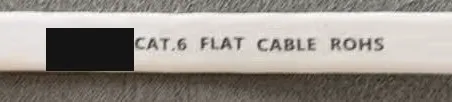
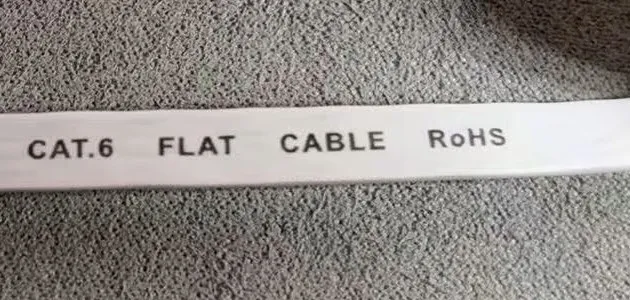
| D | Cat6, “pure copper” | 32 AWG | CCA (suspected) | RoHS only — no UL, no gauge | Not Cat6 |
| E | ”Cat 6e”, 32 AWG | ~34 AWG | CCA (suspected) | RoHS only — no UL, no gauge | Not Cat6 |
Price was a weak predictor of quality: the two failures cost $0.28 and $0.46 a foot, while the most honestly-labeled cable in the group cost just $0.30.
Physical-spec measurements only — gauge, conductor material, wiremap, jacket markings, and construction. We did not run channel certification (no Fluke DSX), so we make no insertion-loss or “passes at 250 MHz” performance claim. The copper-clad-aluminum calls on D and E rest on brittleness, weight, and a microscope, not laboratory elemental analysis — strong physical indicators, not a certified determination. See the scope note near the end.
Every cable passed the plug-in test — that is the trap
All five passed a basic wiremap: eight conductors present, wired straight through, no shorts or split pairs. That is the test most buyers run, and it is close to useless for grading a cable. Continuity says the wires are connected; it says nothing about whether they are thick enough, made of the right metal, or arranged the way Cat6 requires. Those three things — gauge, conductor, and construction — are exactly what a wiremap cannot see, so we measured all three.
What real Cat6 needs: gauge and copper
Cat6 is a construction, not a sticker. Genuine Cat6 uses roughly 23 AWG solid copper for permanent runs, or 24-26 AWG stranded in a flexible patch cord, per ANSI/TIA-568. Two failures show up under a caliper and a knife and never on a tester.
Undersized gauge. Thinner wire has more resistance, drops more signal, and runs hotter. Sample D measured 32 AWG and Sample E about 34 AWG, against Cat6’s ~23 — not a rounding error but a different class of wire. Two cables measured thinner than their own stated gauge: the “Cat 6e” ran ~34 AWG against a printed 32, and a “26 AWG” cable came in near 28. Sample B, at ~28 AWG, is a genuinely thin slim-patch cable — but it prints “30AWG” on the jacket, so the buyer is told. The one cable that undersold itself was Sample A: labeled 24 AWG, measured a fatter 23.
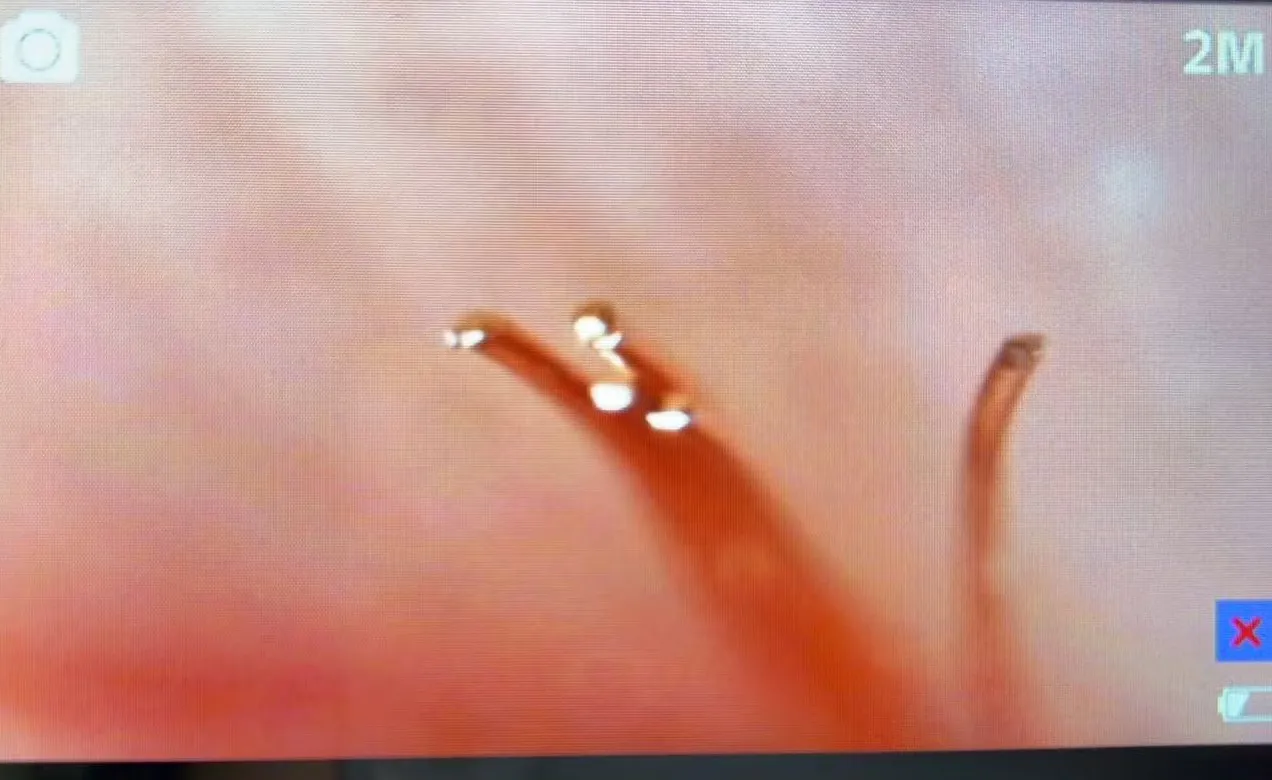
Copper-clad aluminum. CCA is a cheap substitute — an aluminum core under a thin copper skin. TIA-568 calls for solid copper; CCA is non-compliant, higher-resistance, and more brittle. Both flat cables snapped a conductor after a few bends and showed a cooler silver metal beneath the copper at magnification. This matters most on Power-over-Ethernet: on a run feeding a camera, an access point, or a phone, thin gauge and CCA both raise DC resistance, which means heat and voltage drop — a fire and reliability problem, not just lost speed. The branded round cable (Sample C), by contrast, carried real copper.
The cross-section tells the story
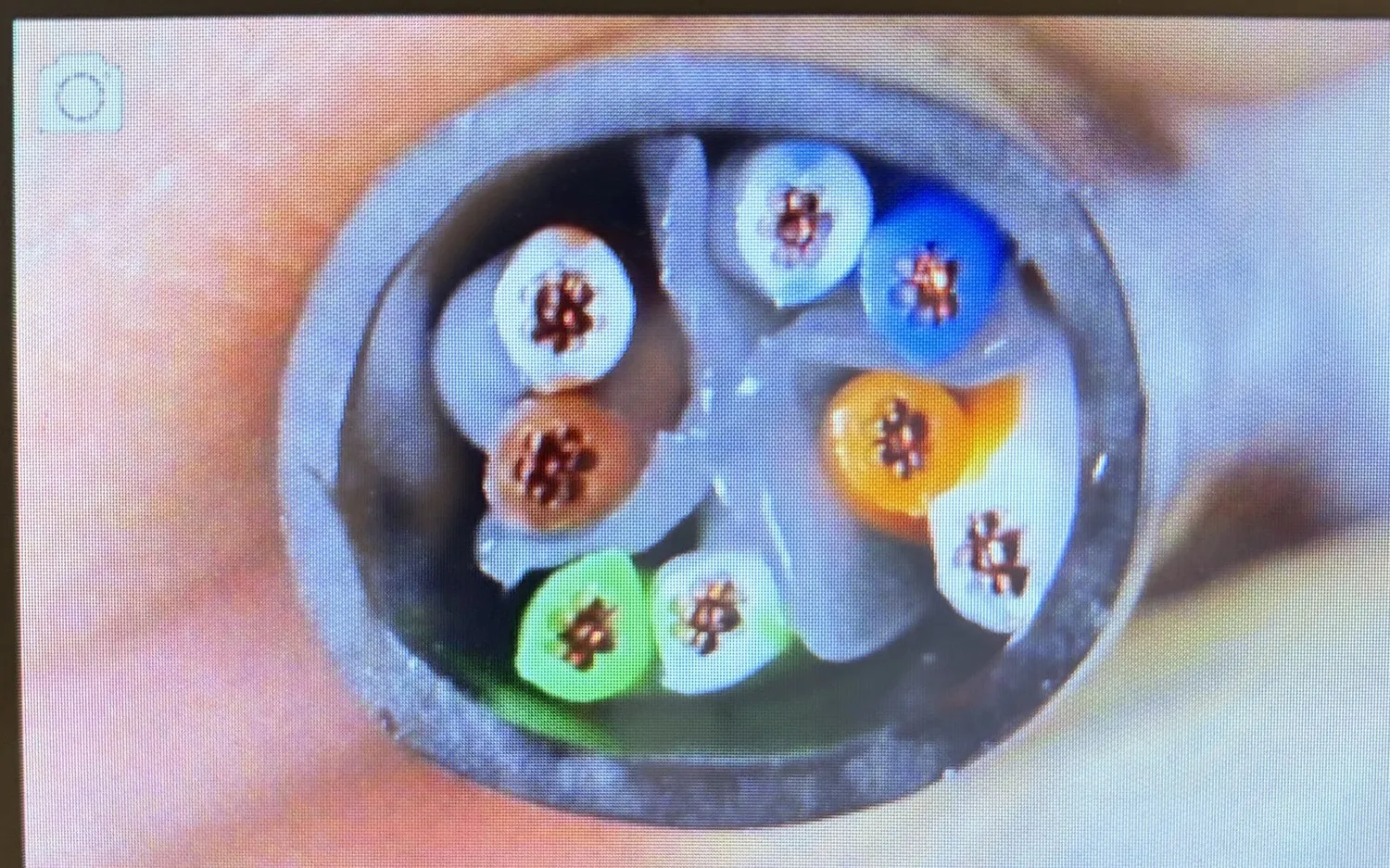
Cut a cable across and the grade is visible before any measurement. Genuine Cat6 (Samples A and C) is round, with eight conductors held in four twisted pairs around a central spline — the plastic separator that keeps the pairs spaced so they cancel each other’s crosstalk. Every conductor shows a copper core.
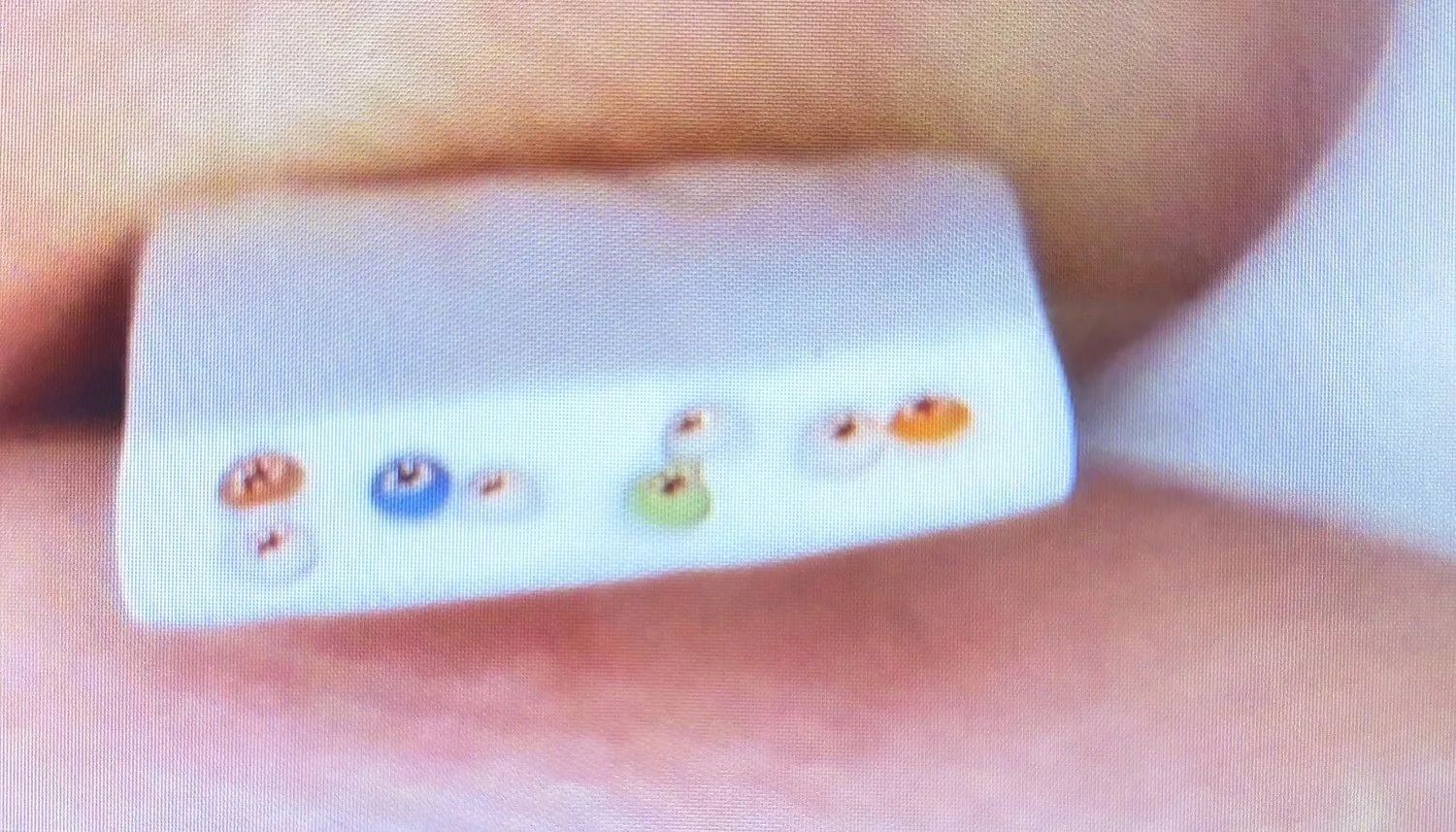
The two flat cables (D and E) are the opposite. The conductors lie in a flat row, with no spline and pairs that are barely twisted at all. Twist rate is the mechanism Cat6 relies on to cancel crosstalk at 250 MHz; a flat, near-parallel layout gives it up by design. Even if the copper were perfect, the geometry cannot meet the spec.
The scale agreed: the two flats weighed the least of the five — about 44 and 62 g per 10 ft, against 46 to 113 g for the round copper cables. Whole-cable weight is a rough screen (a thin flat jacket skews it), but it pointed the same direction as everything else.
What the jacket says — and what a “UL” mark really means
A cable built to spec prints its evidence on the outside; a cable that skips the spec skips the printing too. At the honest end, the genuine Sample A prints a UL file, the gauge, the jacket rating, and the ANSI/TIA-568.2-D standard it is independently verified to — and the cheapest cable, Sample B, prints the same kind of detail.

One nuance worth knowing, because it catches careful buyers: Sample C carries a UL file too, but it is an AWM (Appliance Wiring Material) recognition — UL listing the wire as a safe component, not a TIA-verified Cat6 performance. A “UL” stamp is not automatically a Cat6 pass; read which mark it is. Samples A and B cite a TIA standard; C cites AWM; D and E cite neither.
The two flats, by contrast, print only “Cat.6” and “RoHS” — and RoHS is an EU hazardous-substance rule, not a performance or safety certification. And one of them prints a brand name different from the storefront selling it — relabeled stock, a sign the seller does not control, and may not know, how the cable is built.
Cat 6 vs Cat 6a vs “Cat 6e”
When a listing offers you “Cat 6e,” the honest comparison is against the categories that actually exist:
| Spec | Cat6 | Cat6a | ”Cat 6e” |
|---|---|---|---|
| Standard | ANSI/TIA-568 | ANSI/TIA-568 | None (marketing) |
| Bandwidth | 250 MHz | 500 MHz | Undefined |
| 10G distance | ~55 m | 100 m | Undefined |
| What you buy | A defined spec | A defined spec | Whatever shipped |
10-Gigabit distances are per IEEE 802.3 / TIA-568: Cat6 carries 10GBASE-T to roughly 55 m before alien crosstalk forces a derate; Cat6a carries it to the full 100 m. If you need 10 Gigabit past a short run, the real answer is Cat6a — not a cable with an invented letter.
How to check a “Cat6” cable in 60 seconds
You do not need our kit. Three checks catch most of the fakes:
- Read the jacket. A real cable prints its AWG, a UL file number, and a TIA/ISO standard on the outside. If all it says is “Cat6” and “RoHS,” be suspicious.
- Heft it. Copper is nearly three times as dense as aluminum, so a suspiciously light cable next to a known-good one of the same size is a copper-clad-aluminum flag.
- Nick a conductor. Scrape one wire with a knife. Copper is copper all the way down; a flash of silver underneath is aluminum. And if it snaps after a few bends, that brittleness is aluminum too.
This was a fast spot-check — a real qualification goes further
Be clear about what this is: five cables, one unit each, on a bench — a physical-spec spot-check (gauge, conductor, wiremap, jacket, construction). It is enough to separate honest cable from junk, and it is enough to embarrass a “Cat 6e” listing. It is not a qualification, and we would not source against it.
For an actual sourcing project the bar is much higher. A real qualification adds channel and permanent-link certification on a Fluke DSX-class tester across the full frequency band — insertion loss, near-end and alien crosstalk (NEXT/ANEXT), and return loss, the things a wiremap cannot touch — plus length by TDR, DC-resistance unbalance, a PoE heat-rise check, and sampling across multiple reels and lots, not one unit off a shelf. And it ends in a test report retained per reel or lot, not a screenshot. That is the difference between “looks right on a bench” and “certified to spec, with the records to prove it” — and it is the difference that matters when the cable is going into a building, not a blog post.
How Kestner makes Cat6 — and how to buy it right
If you are sourcing bulk Cat6 or Cat6a cable for a distribution line or an OEM build, this teardown is the whole reason we measure what comes off the line before it ships. Kestner makes Ethernet cable — 1000-ft boxes, solid bare-copper spools, shielded and plenum constructions, and custom patch-cord runs — from lines we have inspected, to a real TIA-568 spec. Every quote states the gauge (AWG), the conductor material (solid copper, not copper-clad aluminum), and the jacket fire rating up front, with the paperwork to back it. When you compare a Cat6 cable supplier, ask for exactly that before the price: the AWG, the copper, and the UL and TIA markings. A quote that cannot produce them has already told you what it is selling. See Ethernet / Cat cables, or talk to Kestner about bulk Cat6 sourcing.
Frequently asked
Is Cat 6e a real standard?
No. ANSI/TIA-568 defines Cat5e, Cat6, Cat6a, and Cat8 — there is no "Cat 6e" category. It is a marketing label, so a "Cat 6e" listing tells you nothing verifiable about the cable. Check the printed gauge, the conductor material, and the standard instead of the name.
What is the difference between Cat 6 and Cat 6e?
There is no defined difference, because "Cat 6e" is not a standard. A cable sold as "Cat 6e" is a Cat6 (or lower) cable with a marketing suffix; its real performance depends on its gauge, its copper, and its shielding, not the letter "e." Treat "Cat 6e" as a caution flag, not an upgrade over Cat6.
What gauge (AWG) is real Cat6?
About 23 AWG solid copper for permanent and horizontal runs, or 24-26 AWG stranded for a flexible patch cord, under ANSI/TIA-568. A conductor of 28 AWG or thinner sold as "Cat6" is undersized: it will not certify to Cat6 and runs hotter under Power-over-Ethernet.
Is copper-clad aluminum (CCA) cable OK for Ethernet?
No. TIA-568 specifies solid copper, and copper-clad aluminum is an aluminum core with a thin copper skin. It is lighter, higher in resistance, more brittle, will not certify to any Cat category, and is a fire and voltage-drop risk on Power-over-Ethernet. Avoid CCA for in-wall and PoE runs.
Is flat Ethernet cable real Cat6?
Flat cable can carry a genuine Cat rating, but the flat form usually drops the center spline and under-twists the pairs — the two features that control crosstalk at Cat6 speeds. Both flat cables in our test were also undersized and showed copper-clad-aluminum signs. Flat cable is fine for a short, low-speed patch; it is a poor choice for a certified or in-wall Cat6 run.
How can I tell if a Cat6 cable is real copper?
Three checks. Read the jacket for the AWG, a UL file number, and a TIA standard. Weigh it against a known-good cable of the same size, because copper is nearly three times as dense as aluminum. And nick one conductor with a knife: copper is copper all the way through, while copper-clad aluminum shows a silver core under the copper skin.
Sources
- Balanced twisted-pair categories (Cat5e/6/6a/8), solid-copper constructionANSI/TIA-568.2-D
- 10GBASE-T over twisted-pair copperIEEE 802.3
- Communications-cable safety (UL 444) and fire rating (CM/CMR/CMP)UL
More in this cluster
Products in this line
Ready to source this to spec?
Kestner builds bulk Cat6 and Cat6a cable in its own factories — solid bare copper, to a real TIA-568 spec, with the gauge and conductor stated up front. One US company that measures the cable it makes before it ships it.
Request a quote