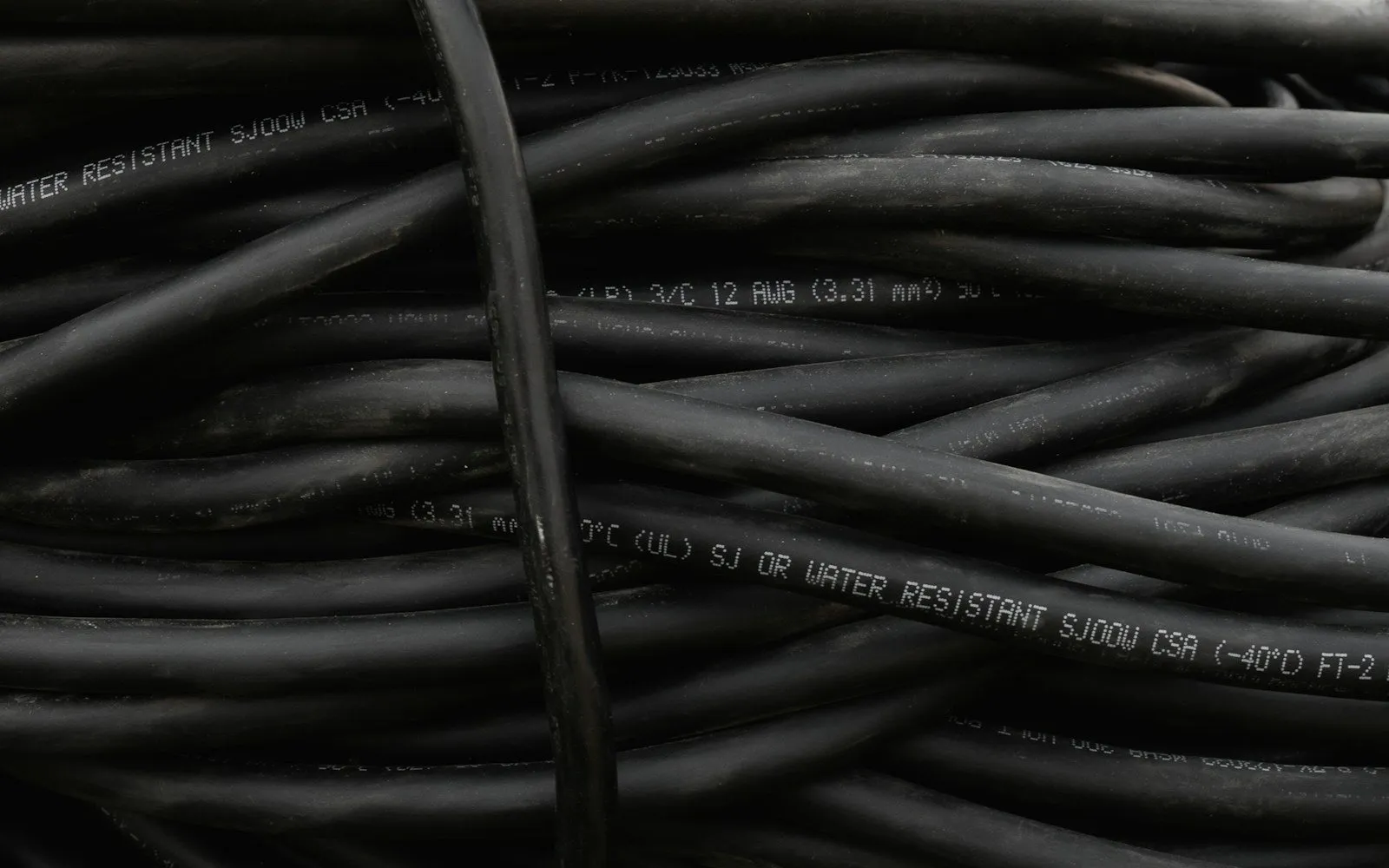
Quick answer
We bench-tested 7 Amazon C13 power cords: every one carried honest copper — 1,587 to 2,724 circular mils, backing the printed 18 or 16 AWG — with correct polarity and a wired ground. The split was the paperwork: all 4 UL file numbers verified in UL Product iQ to real cord factories, while 0 of 3 ETL numbers could be found in the public directory. Kestner Supply builds IEC cordsets on its own lines; this is the buyer-side check we run in reverse.
The short version
- All 7 cords measured real copper at or above their printed gauge — 98% to 115% of nominal circular-mil area. No copper-clad aluminum anywhere.
- All 7 passed polarity, ground continuity, and the brass-blade magnet test. The basics of this market are healthier than the "Cat6" cable market we tested in July.
- Under a 10-minute, ~12.5 A heat soak, 2 of 7 plugs ran hotter than their own cord — an inverted pattern (48.5 °C and 46.5 °C) that points at the molded joint, not the copper.
- Every UL file number traced in minutes to a named cord factory in UL Product iQ. Not one ETL control number could be located in the public directory — including one printed by a major brand.
- Two of seven cords arrived with no identifiable retail brand at all — but the jacket print named the actual factory on both. The anonymity lives in the storefront layer, not the factory layer.
We spent $79 on thirteen C13 power cords across seven Amazon listings — three from established cable brands as references, one heavily-reviewed Amazon brand, one five-pack value brand, and two cords that arrived with no identifiable retail brand at all. Then we tested every claim printed on them: conductor gauge, copper, polarity, grounding, blade material, a ten-minute heat soak at roughly 12.5 A, and every UL and ETL file number, checked against the certification registries. Everything below is our own bench data, and almost all of it can be reproduced at home for under $100 in tools. The short version: the copper is honest across the board — and the certification paper trail split cleanly in half.
What we bought and how we tested it
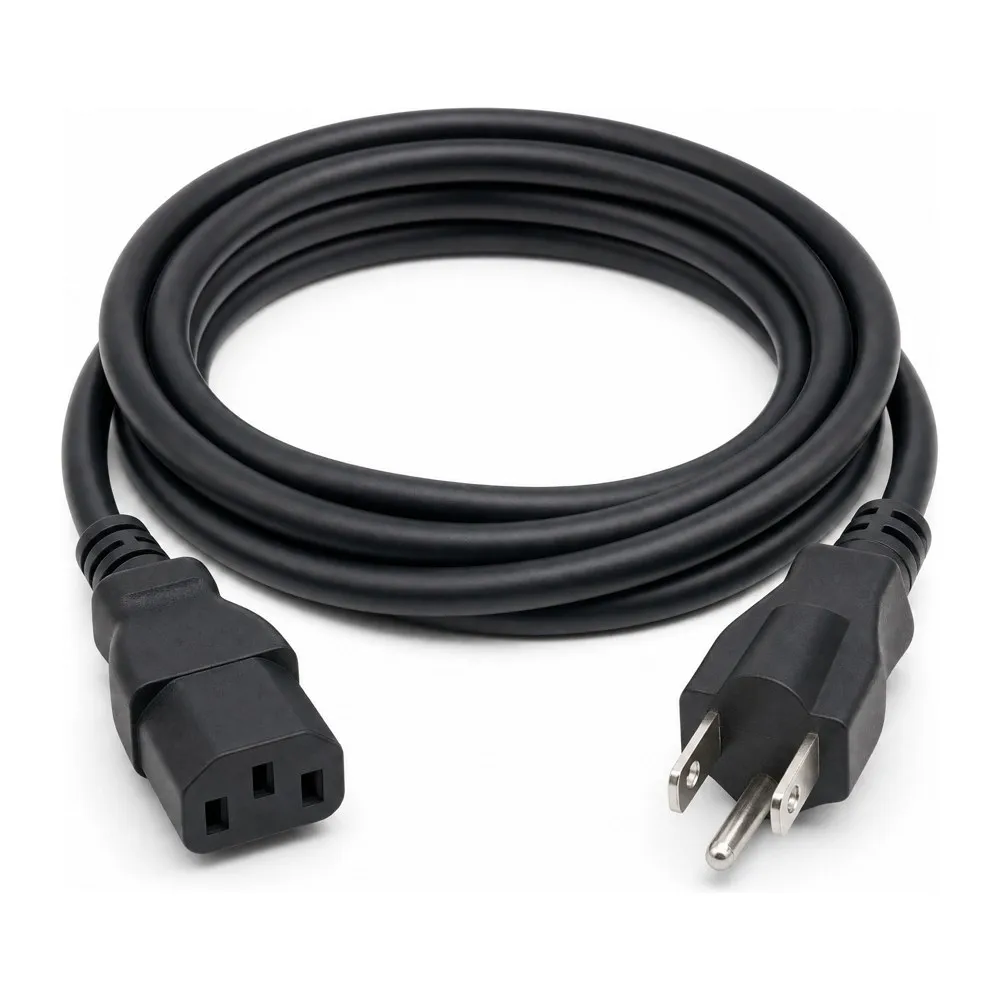
Seven 6-foot C13 cords (NEMA 5-15P wall plug to IEC C13 connector — the standard computer, monitor, and PDU cord defined by IEC 60320), priced from $4.19 to $11.99 per cord. Six print 18 AWG on the jacket; one heavier reference prints 16 AWG. All print 300 V and carry a UL or ETL certification mark with a file number. We anonymize the retail brands here — samples A through G — because the point is the market, not a storefront takedown; the certification file numbers and the factories they resolve to are reported exactly as printed and as the registries returned them.
The test sequence, in the order that preserves evidence: photograph everything, copy the jacket print verbatim, verify the file numbers in the registries, measure length and weight, magnet-test the plug blades (real brass does not stick), then beep out every pin-to-contact pair with a multimeter — conductor count, ground continuity, and hot/neutral mapping, all without cutting. Only then the destructive half: sever the cord, strip one conductor, count strands, measure one strand with calipers, scrape for copper-clad aluminum, and bend a strand to feel for brittleness. The full tool list — multimeter, calipers, a magnet, a kitchen scale — runs about $60; the optional thermal camera used below adds about $130.
The copper: all seven passed
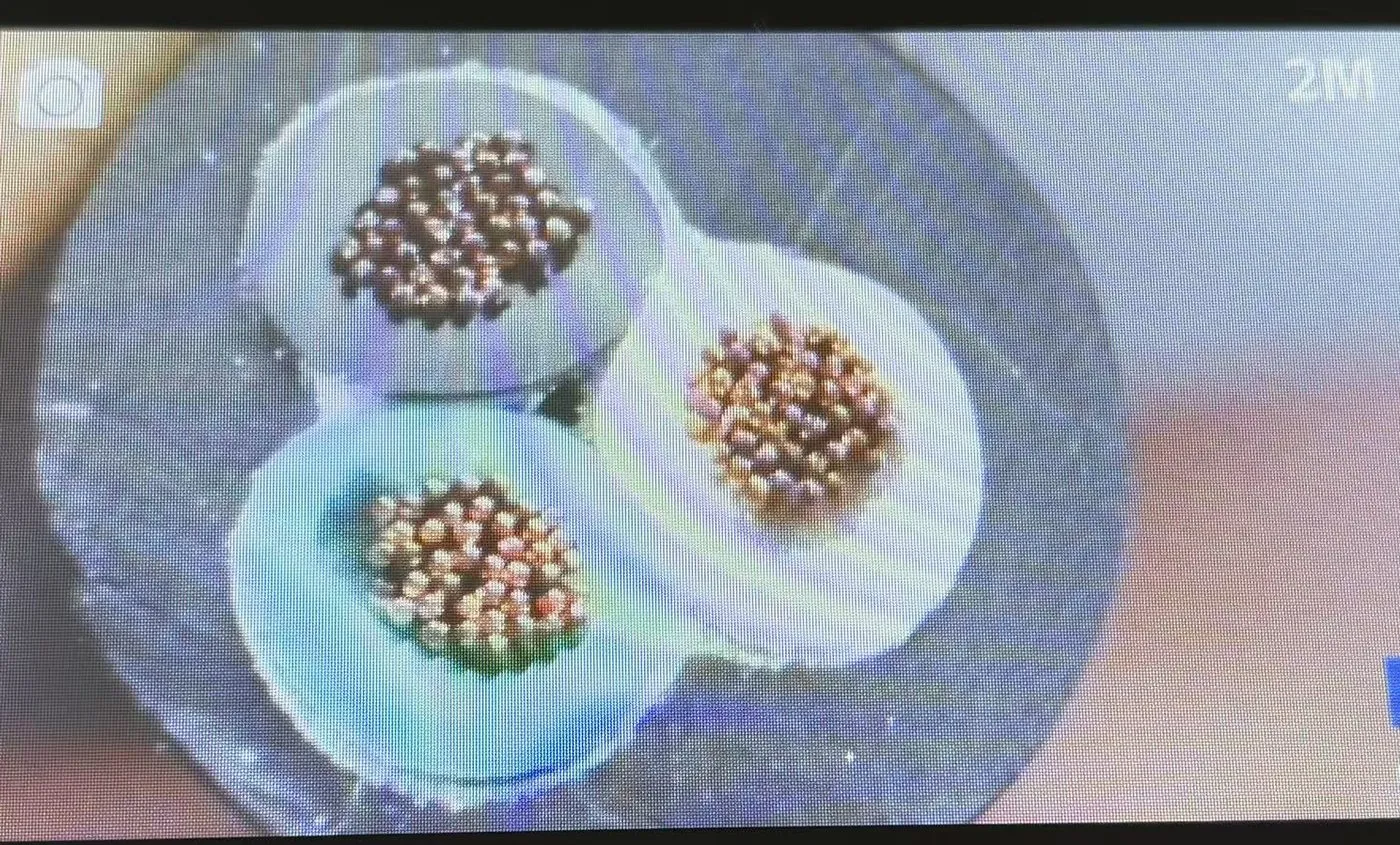
A stranded conductor’s real gauge is arithmetic, not trust: strand count × (strand diameter in mils)² = circular-mil area. Nominal 18 AWG is 1,620 circular mils; 16 AWG is 2,580. Here is every cord we measured:
| Cord | Printed | Strands × ⌀ (mm) | Circ. mils | vs nominal | Copper? |
|---|---|---|---|---|---|
| A · brand ref | 18 AWG SVT | 42 × 0.16 | 1,666 | 103% | copper throughout |
| B · brand ref | 16 AWG SJT | 26 × 0.26 | 2,724 | 106% | copper throughout |
| C · brand ref | 18 AWG SVT | 42 × 0.16 | 1,666 | 103% | copper throughout |
| D · Amazon brand | 18 AWG SVT | 40 × 0.16 | 1,587 | 98% | copper throughout |
| E · 5-pack value | 18 AWG SJT | 47 × 0.16 | 1,865 | 115% | copper throughout |
| F · white-label | 18 AWG SVT | 48 × 0.16 | 1,905 | 118% | copper throughout |
| G · white-label | 18 AWG SVT | 40 × 0.16 | 1,587 | 98% | copper throughout |
Every cord lands between 98% and 118% of its printed gauge — within stranding tolerance at the bottom and genuinely generous at the top. The scrape test showed copper color through every strand on every cord; nothing silvered, nothing snapped early on the bend test. After the “Cat6” cable study — where two of five samples were materially misrepresented — we expected to catch someone here. We did not. Notably, the two unbranded white-labels and the $4.60-per-unit five-pack carried some of the most copper.
Polarity, ground, and blades: no shortcuts found
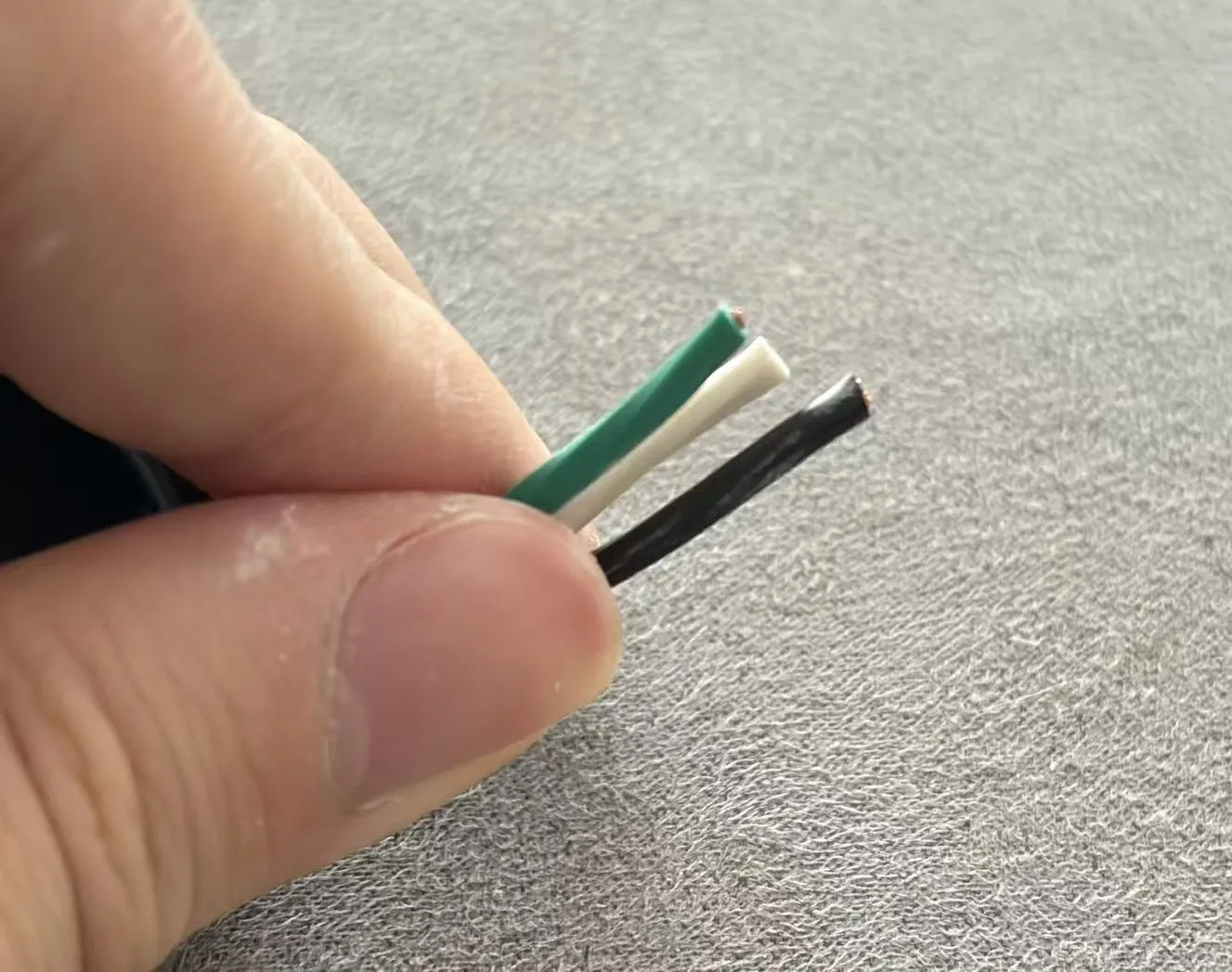
All seven cords beeped out correctly: three continuous conductors, ground pin to ground contact, hot and neutral mapped to the right C13 slots, no crossed pairs. All seven plug blades passed the magnet test — solid brass, not plated steel. This is worth pausing on, because these are the cheapest corners to cut and the most dangerous: a cosmetic ground pin or reversed polarity is invisible from the outside and turns up only when something fails downstream. A $20 multimeter finds either in ninety seconds per cord, without cutting anything.
The heat test: two plugs told a different story
We loaded each cord identically — a 1,500 W ceramic heater through a C14 adapter, roughly 12.5 A, about 25% above the 10 A rating, for ten minutes on a hard floor — and imaged plug, mid-cord, and junction with a thermal camera at five and ten minutes. A healthy cord shows a specific signature: the thin jacket runs warmest (the copper’s I²R heat is right under the surface) while the chunky molded plug bodies run cooler. Five cords matched it. Two inverted it:
| Cord | Max plug (°C) | Max cord (°C) | Pattern |
|---|---|---|---|
| A | 37.0 | 44.7 | healthy — cord warmest |
| B (16 AWG) | 39.8 | 30.9 | coolest cable of all — more copper, less heat |
| C | 37.3 | 42.2 | healthy |
| D | 48.5 | 42.2 | inverted — plug 6.3° over its own cord |
| E | 39.4 | 37.5 | borderline |
| F | 40.0 | 41.3 | healthy |
| G | 46.5 | 40.5 | inverted — plug 6.0° over its own cord |
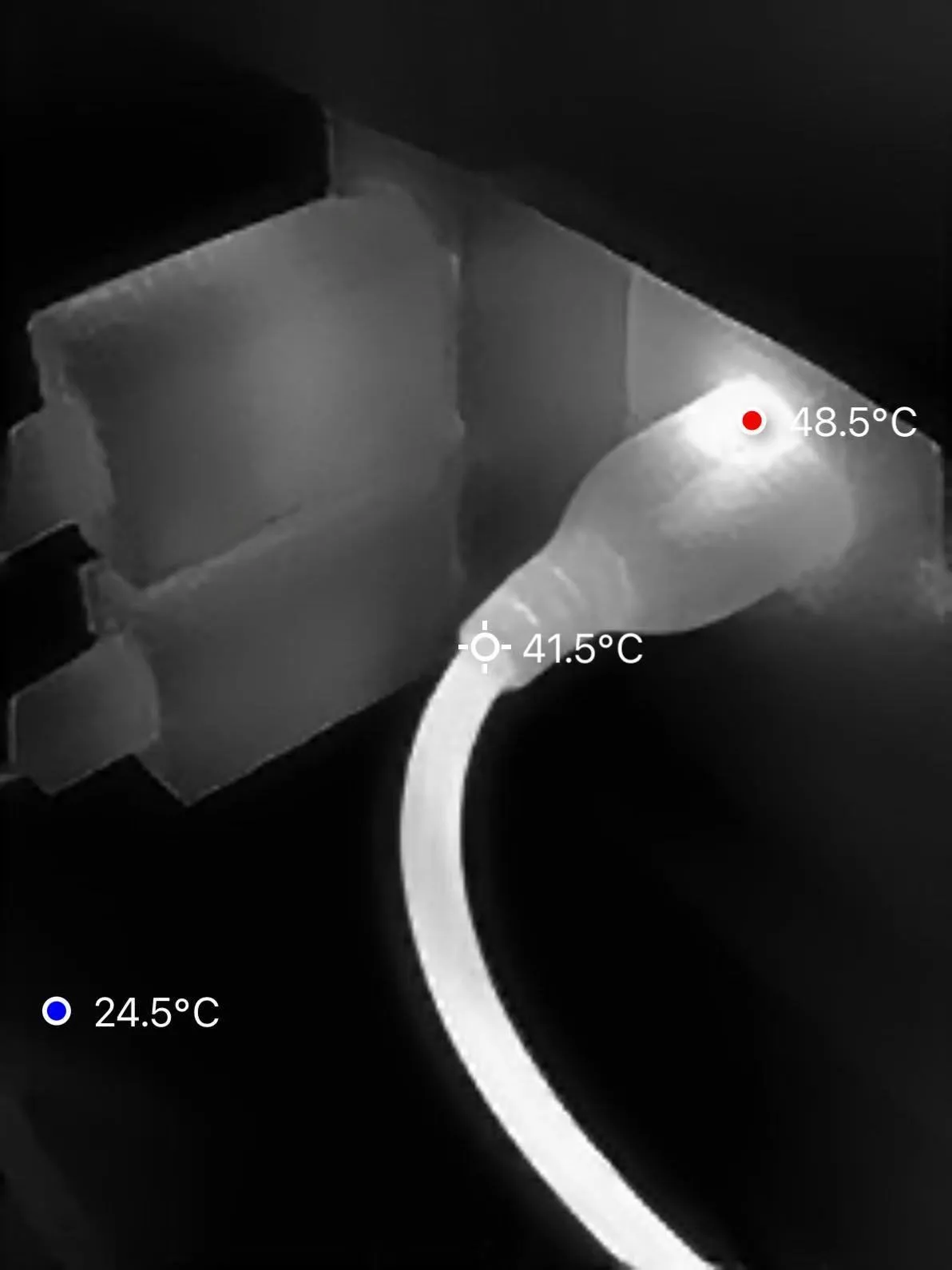
None of these temperatures is dangerous in absolute terms — 48.5 °C is uncomfortable to hold, not melting. The signal is the shape: both hot cords measured honest copper, so the extra heat is being made in one place, almost certainly resistance at the crimp inside the molded plug. And here is the interesting part: cord D’s cable stock traces to one of the most reputable cordage plants in the registry. Good cable, warm plug — the quality fork in this product category runs through the assembly step, not the copper.
Confirming that would mean sawing the plugs open and inspecting the crimps — a destructive autopsy that is beyond the scope of an at-home study like this one. It is exactly what a factory heat-rise and pull-test screen exists to catch during production, cord by cord, before molding.
The certification trail: UL 4-for-4, ETL 0-for-3
Every cord prints a certification mark and a file number on its jacket. We looked all seven up. The result was the cleanest split in the study:
| Cord | Mark | File number | Registry result |
|---|---|---|---|
| A | UL | E135710 | verified — YFC-Boneagle Electric Co Ltd, Flexible Cord |
| B | UL | E250127 | verified — Weihai Hong Lin Electronic Co Ltd, Flexible Cord |
| D | UL | E315167 | verified — I-Sheng Manufacturing (Song Gang), Flexible Cord |
| G | UL | E531417 | verified — Jiangmen Xuzhao Metal Wire Co Ltd, Flexible Cord |
| C | ETL | 5019033 | not found in the public directory |
| E | ETL | 5014787 | not found in the public directory |
| F | ETL | 5018440 | not found in the public directory |
All four UL numbers resolved in UL Product iQ — a free account — in minutes, each to a named cord factory holding a Flexible Cord listing (CCN ZJCZ, plus ZJCZ7 for Canada). The three ETL control numbers returned zero results in the public Intertek directory, including with fuzzy search — and one of those three is printed by a major, reputable brand, which is precisely why we do not call any of them fake. An unverifiable number is not a counterfeit finding; it is a verifiability finding: as the person holding the cord, we could confirm every UL claim and none of the ETL claims. We are in contact with Intertek to verify the three numbers directly and will update this page when we hear back.
Two footnotes from this chapter. First: the two white-label cords that arrived with no retail brand still named their real makers — the jacket prints carried the cordage factory’s name, and the registry confirmed one of them. On Amazon, the anonymity lives in the storefront layer; the factory layer is often perfectly traceable if you read the jacket. Second: while researching one file number, a search engine’s AI answer confidently “verified” it — citing a login-gated database the AI cannot read, on a results page that itself said the number was missing. The registry, checked with your own account, is the only version of that answer worth anything. That applies to our industry’s paperwork generally.
What this means if you buy cords by the thousand
For a one-off office cord, the takeaway is cheap reassurance: even the $4 end of this market carried real copper and a wired ground, and fifteen minutes with a multimeter and a magnet verifies the basics without cutting anything. For a buyer ordering bulk power cords from a supplier, the study points somewhere more specific. The copper was never the variable — the assembly was (two inverted heat signatures out of seven), and the paper was (three marks unverifiable by the buyer holding the product). Neither shows up in a listing photo or a spec row. At volume, the version of this bench you actually want from a power cord supplier is per-lot: incoming cordage verified by resistance and weight, crimps pull-tested and heat-rise sampled during the run, and a test record that ships with the goods — under UL 817, with a file number you can look up yourself before the PO, not after. That applies whether it is a stock C13 or a custom power cord built to your length and plug.
Frequently asked
What gauge is a C13 power cord?
The standard C13 computer cord is 18 AWG, rated 10 A / 125 V; heavier 16 AWG versions are rated 13 A. All seven cords we measured backed their printed gauge — 1,587 to 1,905 circular mils on the 18 AWG samples (nominal is 1,620) and 2,724 on the 16 AWG one (nominal 2,580).
What is the difference between UL Listed and ETL Listed?
Both are OSHA-recognized testing laboratories certifying to the same standards — UL 817 for cord sets. The practical difference we measured is verifiability: all four UL file numbers on our cords could be confirmed in the free UL Product iQ registry in minutes, while none of the three ETL control numbers could be located in the public Intertek directory. An unverifiable number is not proof of a fake — but a verifiable one is proof of a listing.
Are cheap Amazon power cords safe?
On our bench, the copper was honest even at $4.19 — every cord backed its printed gauge with real copper and a wired ground. The residual risks sat elsewhere: two plugs ran hotter than their own cord under load, which points at the molded joint, and three cords carried certification numbers we could not verify. Buy a cord whose file number you can check, and prefer jackets that name the cordage maker.
How do I verify a UL file number on a power cord?
Read the E-number printed on the jacket (for example E250127), create a free account at productiq.ulprospector.com, and search the number. A real cord listing returns the holder company and a Flexible Cord category (CCN ZJCZ, or ZJCZ7 for Canada). It takes about two minutes and costs nothing.
How hot should a power cord get under load?
Loaded to roughly 12.5 A for 10 minutes, our seven jackets peaked between 30.9 and 44.7 °C — about 20 °C above room temperature at the warmest, and warm to the touch. The pattern matters more than the number: a healthy cord runs warmer along the cable than at the plug. A plug that outglows its own cord is concentrating heat in one joint.
Sources
- UL certification registry (file numbers, holders, categories)UL Product iQ
- ETL certification registry (control numbers)Intertek Directory of Listed Products
- Cord sets and power-supply cords — the governing standardUL 817
- C13/C14 appliance coupler dimensions and ratingsIEC 60320-1
More in this cluster
Products in this line
Ready to source this to spec?
This bench is our production floor run in reverse. On our own lines, gauge is verified by resistance-per-length on every incoming reel, crimps are pull-tested and heat-rise sampled, and every lot ships with its test record — so the cord you spec is the cord that arrives. If you buy cordsets by the thousand, that paper trail is the difference this study kept pointing at.
Request a quote