
Quick answer
A C19 power cord is the high-current version of the familiar C13: the same IEC 60320 family, but rated 16 A under IEC and 20 A under UL — roughly double what a C13 carries — on 12 AWG copper instead of 18. It powers PDUs, UPS inputs, and servers whose supplies outgrow a C13. Kestner Supply builds C19/C20 cordsets on its own lines, to length, in UL/cUL-listed construction.
The short version
- C19/C20 = the rectangular 16 A (IEC) / 20 A (UL) couplers; C13/C14 = the everyday 10 A (IEC) / 15 A (UL) ones. The connector families do not intermate — the aperture keeps a 10 A cord out of a 20 A socket by design.
- C20 is the inlet (male, on the PDU, UPS, or server); C19 is the connector (female, on the cord). A "C19 to C20" cord is the standard in-rack jumper.
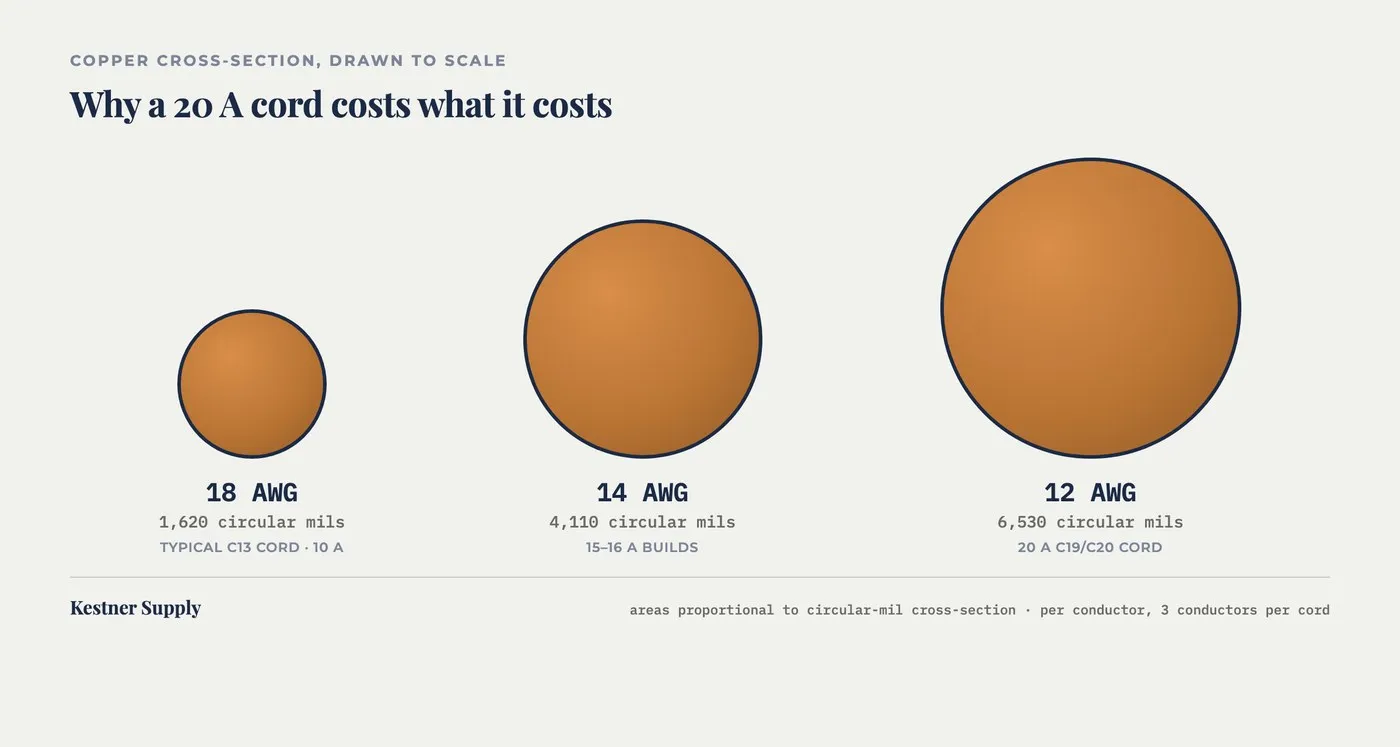
- The copper is the spec: a 20 A cord wants 12 AWG (≈6,530 circular mils) — about four times the copper of a C13 cord's 18 AWG. A "C19 cord" on thin conductors is a heater, not a cord.
- Four configurations cover most racks: C19–C20 (in-rack), C19 to NEMA 5-20P (120 V / 20 A branch), C19 to L6-20P (208–250 V locking), and C19 to L5-20P. Match the plug to the branch circuit, not the other way around.
- Dense racks run 208–240 V for a reason: the same 5 kW rack draws ~24 A at 208 V but ~42 A at 120 V. Your cords need the 250 V rating and the breaker math needs the NEC 80% continuous rule.
The C13 cord that powers most of the world’s IT gear tops out at 10 A under IEC 60320 — and a modern rack blows past that long before the rack is full. That is what the C19 power cord exists for: the same connector standard, scaled up to 16 A under IEC and 20 A under UL, on conductors with roughly four times the copper. This guide covers what the C19/C20 pair actually is, the four cord configurations that power most racks, the gauge and voltage math that keep them safe at 20 A, and what to check when you buy them in quantity.
C19 vs C13: the same standard, twice the current
Both couplers come from IEC 60320 — the standard our pillar reference walks through sheet by sheet. The C19/C20 pair is the rectangular, larger-aperture family; the ratings and the construction scale together:
| Coupler pair | IEC rating | UL rating (NA) | Typical conductor | Where it lives |
|---|---|---|---|---|
| C13 / C14 | 10 A | 15 A | 18–16 AWG | PCs, monitors, 1U servers, most IT gear |
| C19 / C20 | 16 A | 20 A | 12 AWG | PDUs, UPS inputs, high-draw servers, chassis switches |
Two details matter in practice. First, the families do not intermate — a C13 will not seat in a C20 inlet. That is a feature: the aperture physically keeps 18 AWG cordage out of a 20 A socket. Second, the naming convention trips everyone once: even numbers are inlets (male, on the equipment), odd numbers are connectors (female, on the cord). The socket on the back of a PDU is a C20; the cord end that plugs into it is a C19. So the standard in-rack jumper — PDU to server, UPS to PDU — is a C19 to C20 power cord, and the search term “C20 power cord” usually means the same physical cord described from the other end.
The four configurations that cover most racks
A C19 cord is defined by what is on the far end. Four builds cover the large majority of deployments:
| Cord | Circuit it fits | Notes |
|---|---|---|
| C19 to C20 | In-rack (PDU → equipment, UPS → PDU) | The workhorse jumper; buy by length, 12 AWG |
| C19 to NEMA 5-20P | 120 V / 20 A branch (5-20R receptacle) | 5-20P has a perpendicular neutral blade; fits the T-slot 5-20R only |
| C19 to L6-20P | 208–250 V / 20 A locking branch | Twist-lock; the standard for dense racks on 208 V |
| C19 to L5-20P | 120 V / 20 A locking branch | Locking version of the 5-20; less common in new builds |
The rule that prevents most ordering mistakes: match the plug to the branch circuit that exists, not the cord you wish fit. A 5-20P will not enter a standard 5-15R receptacle — by design, per NEMA WD-6 — and an L6-20P assumes a 250 V locking circuit an electrician provisioned on purpose. If the receptacle at the wall is a 5-15R, the branch is a 15 A circuit and no cord choice makes it a 20 A one.
The copper math at 20 amps
The gauge is not a detail at this rating — it is most of what you are buying. A 20 A cord wants 12 AWG conductors, about 6,530 circular mils of copper each — four times the cross-section of the 18 AWG (1,620 CM) inside a typical C13 cord. Some 15–16 A builds legitimately run 14 AWG (4,110 CM). What should make you look twice is any “C19 cord” whose jacket will not state its gauge, or whose price implies it could not contain that much copper — the copper is the cost.
The verification method is the same one from our seven-cord teardown, and it scales: read the jacket print (gauge, SJT or better, 250 V, VW-1, a UL file number), verify the file number in UL Product iQ for free, and if you cut one open, count strands × strand diameter² — the arithmetic doesn’t care what the listing said. At 12 AWG the heat margin is real: the same load that warms a marginal conductor at 10 A will cook a bad crimp at 20.
Why dense racks run 208 V — and what it means for the cord

High-density racks in North America standardize on 208–240 V distribution, and the arithmetic explains why: a 5 kW rack draws about 24 A at 208 V versus about 42 A at 120 V. Higher voltage means fewer amps for the same watts — smaller conductors, fewer branch circuits, less copper heating — and switching power supplies run a measurable point or two more efficient at the higher input. That is why the C19/C20 tier and 208 V arrive together: once a rack’s draw pushes past what a 120 V / 15 A circuit delivers, the economical answer is usually a 208 V circuit through C19 cordage, not more 120 V whips.
Two planning numbers to keep honest. Cords: a proper C19/C20 cordset is rated 250 V — confirm it on the jacket, not the listing. Circuits: the NEC treats rack loads as continuous, and continuous loads size at 80% of breaker rating — a 20 A circuit plans to 16 A. A “20 A cord on a 20 A breaker” is not 20 A of usable headroom, and PDU vendors’ input specs already assume you know that.
Buying C19/C20 cords in quantity
The checklist is short because the teardown series did the long version: (1) jacket print states 12 AWG, SJT or heavier, 250 V, VW-1, and a UL or cUL file number; (2) the file number resolves in UL Product iQ to a real cordset or flexible-cord listing — two minutes, free, and it filters more bad cords than any spec sheet; (3) the plug matches the branch circuit actually provisioned; (4) at volume, ask how gauge and crimps are verified per lot — resistance-per-length on the cordage and pull-force plus heat-rise sampling on terminations is the answer you want to hear; and (5) the duty math is the same for a C19 as for any connectorized cord — HTS 8544.42.90, origin-dependent — which the HTS reference for power cords breaks down with current rates.
Over- and under-buying both cost real money at this tier: 12 AWG copper is expensive enough that nobody should pay for a 20 A cord where a C13 genuinely serves, and cheap enough relative to one melted PDU inlet that nobody should discover a 16 AWG “C19 cord” the hard way.
Frequently asked
What is the difference between a C13 and a C19 power cord?
Current rating and size. C13/C14 couplers are rated 10 A under IEC 60320 (15 A under UL in North America) and run on 18–16 AWG conductors; C19/C20 are the larger rectangular couplers rated 16 A IEC / 20 A UL on 12 AWG conductors. They are deliberately non-intermateable, so a low-current cord cannot end up feeding a high-current load.
What is a C19 power cord used for?
Anywhere a rack device draws more than a C13 can carry: PDU and UPS inputs, high-wattage server and blade-chassis power supplies, and network chassis gear. The common builds are C19-to-C20 jumpers inside the rack and C19 cords with NEMA 5-20P, L6-20P, or L5-20P wall plugs at the branch circuit.
What gauge should a C19 power cord be?
12 AWG for 20 A duty — about 6,530 circular mils of copper per conductor, roughly four times a C13 cord's 18 AWG. 14 AWG appears on some 15–16 A builds, but if the cord is sold for 20 A, the jacket should print 12 AWG and SJT (or better), and the strand math should back it.
Can I use a C19 cord on 240 V?
Yes — properly built C19/C20 cordsets are rated 250 V, and 208–240 V distribution is exactly where they usually live in North American racks. Check the jacket print for the voltage rating and match the wall plug (L6-20P for locking 250 V circuits) to the branch receptacle.
Why do data centers use 208 V instead of 120 V?
More watts per amp. A 5 kW rack draws about 24 A at 208 V versus about 42 A at 120 V — smaller conductors, fewer circuits, and power supplies run measurably more efficient at the higher input. That is why high-density racks standardize on 208–240 V PDUs fed through C19/C20 cordage.
Sources
- C13/C14 and C19/C20 coupler ratings and dimensionsIEC 60320-1
- Cord sets and power-supply cords — the governing standardUL 817
- NEMA plug and receptacle configurations (5-15, 5-20, L5/L6)NEMA WD-6
- Branch-circuit continuous-load sizing (the 80% rule)NFPA 70 (NEC) §210.20
More in this cluster
Products in this line
Ready to source this to spec?
C19/C20 is where cord quality stops being invisible: at 16–20 A, a thin conductor or a lazy crimp announces itself as heat. Kestner builds C19/C20 cordsets and PDU whips on its own lines — 12 AWG verified by resistance per lot, crimps pull-tested and heat-rise sampled, UL/cUL listed, cut to your length with your label. Send the plug type and length and we will quote it built.
Request a quote