Verified · updated monthly · changelog
The efficiency number on a power adapter spec sheet is usually not a measurement. For an external AC-DC supply, the US Department of Energy sets a minimum average efficiency as a formula keyed to nameplate output power — so a 24 W adapter that claims exactly 86.2% and a 30 W adapter that claims exactly 86.95% are both quoting the DoE Level VI minimum for their wattage, copied onto the sheet. Once you know that, the rest of the document becomes much easier to read: some lines are obligations, some are design choices, and only a few are claims worth arguing about.
This page walks an external power supply spec sheet block by block, in the order the blocks appear. The values shown as typical are the ones we write on our own sheets as a power adapter manufacturer building mains-input units in the 18–36 W range; the regulatory values are cited. Read it against whatever sheet a supplier has sent you — the questions at the end are the ones worth putting in an email.
Efficiency: a formula, not a claim
DoE Level VI has applied to external power supplies sold in the US since February 2016. For a single-voltage external AC-DC supply at basic voltage — meaning nameplate output of 6 V or more — the minimum average active-mode efficiency is:
| Nameplate output power (Pno) | Minimum average efficiency | Max no-load power |
|---|---|---|
| ≤ 1 W | ≥ 0.5 × Pno + 0.160 | ≤ 0.100 W |
| > 1 W to ≤ 49 W | ≥ 0.071 × ln(Pno) − 0.0014 × Pno + 0.67 | |
| > 49 W to ≤ 250 W | ≥ 0.880 | ≤ 0.210 W |
| > 250 W | ≥ 0.875 | ≤ 0.500 W |
Efficiency here means the average of four readings — at 25%, 50%, 75%, and 100% of rated load — not a single best-case point. Worked out for common wattages:
| Rated output | Level VI minimum | What a compliant sheet typically states |
|---|---|---|
| 18 W | 85.00% | 85% |
| 24 W | 86.20% | 86.2% |
| 30 W | 86.95% | 86.95% |
| 36 W | 87.40% | 87.4% |
| 56 W | 88.00% (flat, above 49 W) | 88% |
If the sheet in front of you states a number that matches this table to the decimal, you are looking at the legal floor written down, not bench data. That is not dishonest — it is how the industry writes these documents — but it means the sheet tells you the product is compliant, not how good it is. 
If efficiency actually matters to your thermal budget or your energy claims, ask the supplier for the test report with the four load points on it. A manufacturer has one; a trading company has to go and request it, and the delay tells you which you are dealing with.
Where Level VI does not reach
Two common cases fall outside the standard, and buyers routinely compare across them without noticing:
- Car chargers and other DC-input supplies. The DoE definition covers circuits converting household mains current; a DC-DC-only supply that cannot run on household mains is excluded. A 12/24 V car charger therefore has no Level VI obligation, which is why one may honestly specify 70% minimum efficiency next to a wall adapter’s 86%. The parts are not comparable on that line.
- AC-AC linear transformers. These are external power supplies by definition, but a linear design often cannot meet the Level VI curve. A sheet that quotes a healthy-looking efficiency and then states it does not comply with Level VI is flagging a real problem you must resolve before selling the product into the US — not a footnote.
Input block
| Line | Typical value | What it tells you |
|---|---|---|
| Input voltage & frequency | 90–132 Vac, 57–63 Hz | A US-only unit. A universal-input part reads 90–264 Vac, 47–63 Hz. Check this before assuming you can ship the same SKU to the EU. |
| Steady-state input current | ≤ 0.5 A (18 W), ≤ 0.6 A (24 W) | Sizes the upstream fuse and the mains cordset. |
| Inrush current | ≤ 50 A at 132 Vac, cold start | The surge at power-on. It matters when many units share a branch circuit or a relay — ganged devices trip breakers at turn-on, not in service. |
| No-load consumption | < 0.1 W at 115 Vac | The Level VI ceiling for a sub-49 W part. A sheet without this line is incomplete. |
Output block
| Line | Typical value (12 V rail) | What it tells you |
|---|---|---|
| Voltage accuracy | 11.4–12.6 V | The band the output must stay inside across all conditions — here ±5%. |
| Line regulation | ±1% | Drift as mains voltage moves across its range. |
| Load regulation | ±5% | Drift from no load to full load. If your device has a tight rail tolerance, this is the number that decides whether the adapter suits it. |
| Ripple & noise | 200 mV max | Only meaningful with its measurement setup: 20 MHz bandwidth limit, output bypassed with a 0.1 µF ceramic and a 10 µF electrolytic. Multi-port USB chargers commonly specify 500 mV. |
| Turn-on delay | ≤ 3 s to steady state | Matters for devices that must boot within a deadline after power-up. |
| Hold-up time | ≥ 10 ms at full load | How long the rail survives a mains dropout — about half a cycle at 60 Hz. This is your window to flush state on power loss. |
A ripple figure quoted without a bandwidth limit is not comparable to one that states it. Two suppliers can differ by a factor of two on the same hardware purely through measurement setup, so read the note under the table before you read the number in it.
Protection block
Protection is the block most often written as prose and least often written with numbers. Presence is not a specification — trip points are. What a complete sheet names:
| Protection | Typical specification (12 V rail) | Recovery |
|---|---|---|
| Over-voltage (OVP) | Trips below 18 V | Auto-recover once the fault clears |
| Over-current (OCP) | Set above rated load — e.g. 3.0 A on a 2.0 A part | Auto-recover |
| Short circuit (SCP) | Self-limiting, no damage from continuous or intermittent shorts | Auto-recover |
| Overshoot / undershoot | ≤ 10% of nominal at turn-on and turn-off, no polarity reversal | — |
| Brown-out | Clean ON/OFF transitions with no oscillation | — |
Two questions to ask about any protection line. Where does it trip, and does it latch or auto-recover? A latching supply that needs a mains cycle to reset is a field-service call in an unattended installation; an auto-recovering one may oscillate into a persistent fault. Neither is wrong, but the sheet should say which you are getting.
Safety block
These three lines are the ones a safety agency will look at, and the ones a serious factory can produce test records for on request.
| Test | Typical specification |
|---|---|
| Hi-pot (dielectric withstand) | 3.0 kV AC rms, primary to secondary, 3 s, 10 mA trip — switching adapter. Linear transformers commonly 2.8 kV AC, 1 s, 1 mA cutoff. |
| Insulation resistance | > 50 MΩ at 500 V DC, primary to secondary |
| Leakage current | ≤ 0.25 mA at 132 Vac |
Hi-pot is a 100% production test, not a type test — every unit should see it on the line, and the sheet is describing what the line is set to. 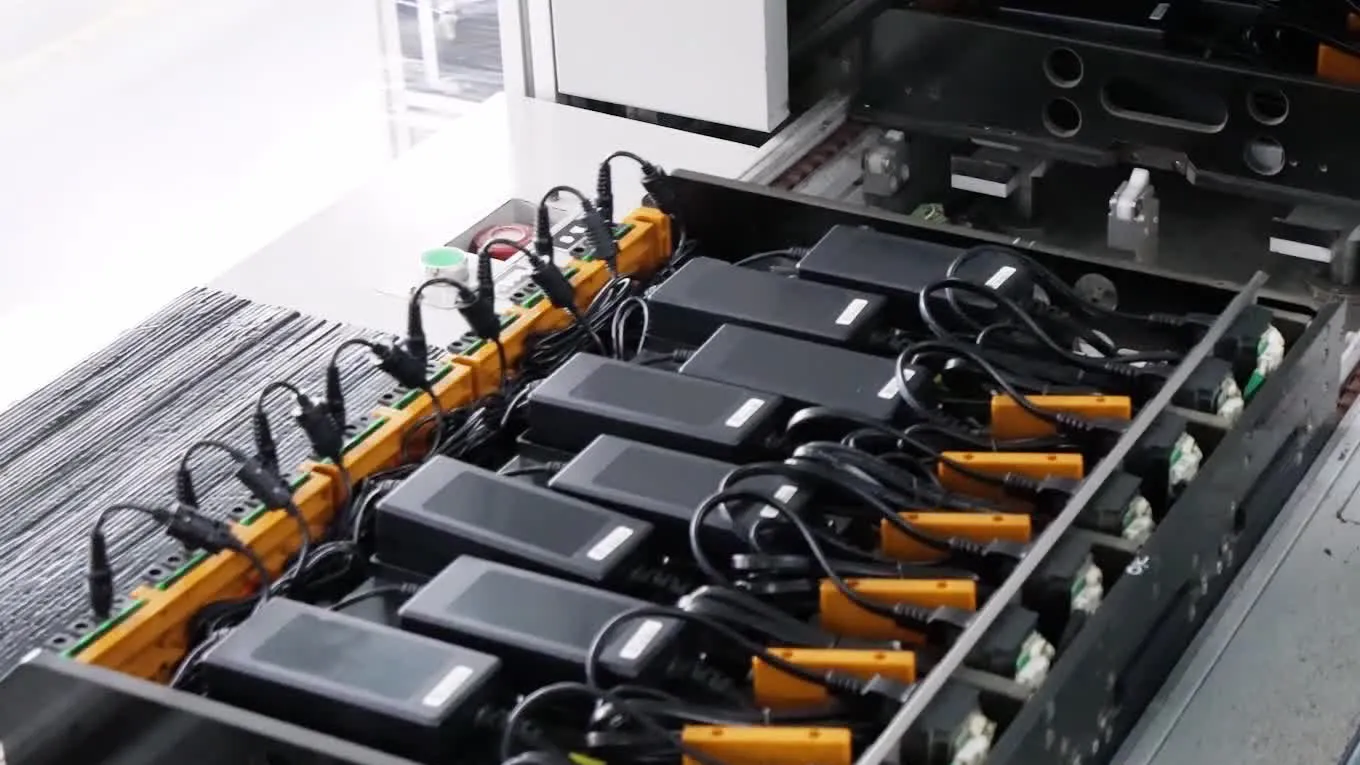
Ask whether the test is logged per unit and whether you can have the records. The answer separates a factory from a trading company faster than most questions in a supplier audit. How we run ours is described on our quality page, and what we build is on the manufacturing page.
EMC and immunity
The EMI line is usually one entry — FCC Part 15 Class B for a US consumer-adjacent product. The immunity block is where sheets get thin: a standards list with no levels and no performance criteria tells you nothing. A complete block looks like this:
| Standard | Phenomenon | Typical level |
|---|---|---|
| IEC 61000-4-2 | Electrostatic discharge | ±8 kV air, ±4 kV contact |
| IEC 61000-4-3 | Radiated RF field | 3 V/m, 80–1000 MHz, 80% AM at 1 kHz, criterion A |
| IEC 61000-4-4 | Electrical fast transient / burst | 1 kV on the AC line |
| IEC 61000-4-5 | Surge | 1 kV line to line |
| IEC 61000-4-6 | Conducted RF | 3 V rms, 0.15–80 MHz, criterion A |
| IEC 61000-4-11 | Voltage dips and interruptions | 0% for 250 cycles, 40% for 5 cycles, 70% for 5 cycles |
Performance criterion A means the unit must keep working normally during the disturbance — not merely survive it and recover. A sheet naming the standard but not the criterion is leaving out the part that matters.
Mechanical and environmental
The mechanical block is short and is where most late-stage surprises live, because it is the block buyers skim.
- Output cable — e.g. 2468 20AWG, 1800 mm, black. The wire type and gauge set the voltage drop at the far end. On a long lead at full current, an undersized conductor can put the load below its minimum input voltage while the adapter itself is perfectly in spec.
- Connector — barrel size and polarity, or to your drawing. Confirm polarity in writing; centre-positive is common but not universal. On an OEM or custom build this line is yours to set, so set it explicitly rather than inheriting a default.
- Dimensions and weight — e.g. 76 × 51 × 31 mm. Check blade-to-body clearance against the outlet strips your customer actually uses.
- Operating range — typically 0–40 °C, 10–90% RH, with storage at −20–60 °C. If your product lives in an unheated cabinet or a vehicle, 0 °C is a real constraint.
- Acoustic noise — under 25 dBA at 1 m. Relevant in ward, studio, and office installations, where a faint transformer whine generates complaints no electrical test would predict.
What should make you suspicious
A spec sheet is a manufacturing document. When it reads like a brochure, it usually was not copied from a test report:
- Efficiency at one load point instead of the four-point average the standard requires.
- Ripple with no bandwidth limit or measurement setup stated.
- No no-load figure — an odd omission, since it is a mandatory limit.
- Protection listed without trip points, or with no statement of latch versus auto-recovery.
- An EMC section with standard numbers but no levels and no performance criteria.
- No revision number, date, or change history. A sheet that has never been revised has usually never been tested against.
- Certification logos without file numbers. A UL mark is checkable; ask for the file number and check it.
None of these prove a bad part. All of them tell you the document was assembled to close a sale rather than to control a build — which means the thing you are agreeing to buy has not actually been written down yet.
Using this to evaluate a supplier

The sheet is a proxy for how a supplier works. A contract manufacturer that writes its own sheets can answer follow-up questions in the same call: where OCP trips, whether hi-pot is logged per unit, which load points the efficiency average came from. A supplier reselling someone else’s product has to go and ask, and the answers come back in fragments.
Three requests separate the two quickly, and none of them are unreasonable to make before a first order:
- The four-point efficiency test report, not the sheet’s summary figure.
- The hi-pot log format — per unit, with the trip setting on it.
- A sheet revision history with dates, showing the document has been changed at least once.
We build wall-mount, desktop, and USB-C adapters on our own lines, and write the sheets that go with them. If you are comparing our sheet against an incumbent supplier’s, the comparison we would rather you make is on these three documents than on the summary numbers.
Sources
- Energy conservation standards for external power supplies (Level VI)10 CFR 430.32(w)
- Definitions — "external power supply", "commercial and industrial power supply"10 CFR 430.2
- Uniform test method for measuring energy consumption of external power supplies10 CFR Part 430, Subpart B, Appendix Z
- Safety standard for audio/video, information and communication technology equipmentUL/IEC 62368-1
- Electromagnetic compatibility — testing and measurement techniquesIEC 61000-4 series
Frequently asked
What efficiency does DoE Level VI require?
For a single-voltage external AC-DC supply at basic voltage (nameplate output ≥6 V) rated over 1 W and up to 49 W, the minimum average active-mode efficiency is 0.071 × ln(Pno) − 0.0014 × Pno + 0.67, where Pno is nameplate output power in watts. That works out to 85.0% at 18 W, 86.2% at 24 W, and 86.95% at 30 W. Above 49 W and up to 250 W the requirement is a flat 88.0%. Efficiency is the average of readings at 25%, 50%, 75%, and 100% of rated load.
Why does the efficiency number on my spec sheet look oddly specific?
Because it usually is not a measurement — it is the legal minimum for that wattage, computed from the DoE Level VI formula and written straight onto the sheet. A 24 W adapter claiming exactly 86.2% and a 30 W adapter claiming exactly 86.95% are both quoting the formula output, not bench results. Ask for the actual test report if you need real numbers.
What is the maximum no-load power draw allowed?
Under DoE Level VI, 0.100 W for an external power supply rated up to 49 W, 0.210 W from over 49 W to 250 W, and 0.500 W above 250 W. A sheet reading "<0.1 W" is stating the legal ceiling for a sub-49 W unit, not a design margin.
Do car chargers have to meet DoE Level VI?
No. The DoE definition of an external power supply covers circuits that convert household mains current, and DC-DC-only supplies that cannot run on household mains are outside it. A 12/24 V car charger takes a DC vehicle input, so Level VI does not reach it. That is why a car charger sheet may state 70% efficiency while a wall adapter of similar wattage states 86% — the two numbers are measured against different obligations, not different quality bars.
What is a normal hi-pot test voltage for a power adapter?
For a mains-input switching adapter with reinforced primary-to-secondary insulation, 3.0 kV AC rms applied for 3 seconds with a 10 mA trip threshold is typical, and that is what we specify. Linear transformers are commonly tested lower — 2.8 kV AC for 1 second with a 1 mA cutoff. The sheet should also carry an insulation-resistance figure, normally above 50 MΩ at 500 V DC.
What ripple and noise is acceptable on a 12 V adapter?
200 mV peak-to-peak maximum is the usual specification on a 12 V external adapter, measured on a 20 MHz bandwidth-limited oscilloscope with the output bypassed by a 0.1 µF ceramic and a 10 µF electrolytic capacitor. Multi-port USB chargers are looser — 500 mV is common. The measurement conditions matter as much as the number: a ripple figure with no stated bandwidth limit is not comparable.
What does hold-up time mean on a power supply spec sheet?
Hold-up time is how long the output stays in regulation after mains power is removed. Ten milliseconds at nominal input and full load is the common floor, which covers roughly half a mains cycle at 60 Hz. If your device needs to flush state or close a file on power loss, this is the line that tells you whether it can.
How do I evaluate a power adapter supplier from its spec sheet?
Ask for three documents the sheet implies but does not contain: the four-point efficiency test report behind the stated average, the hi-pot log format showing the test is run and recorded per unit, and the sheet revision history with dates. A manufacturer that writes its own sheets can produce all three and answer follow-up questions in the same call. A supplier reselling another factory output has to go and ask, and the answers come back piecemeal — which is the useful signal.
What should an OEM power supply spec sheet include?
An OEM or custom build should have every line the standard sheet has, plus the ones you set: output voltage and current, connector type and polarity, cable type, gauge and length, housing and plug style, agency marks required for your destination markets, and any labelling or logo. Fix polarity and cable gauge in writing — those two cause most late-stage surprises, because voltage drop on a long undersized lead can put your load under its minimum input voltage while the adapter itself still measures in spec.
What should make me suspicious of a spec sheet?
Efficiency quoted at one load point rather than as a four-point average; ripple with no bandwidth limit or measurement setup; no no-load figure; protection described as present but with no trip points; an EMC section listing standard numbers without levels or performance criteria; and no revision number or date. Any one of those means the sheet was assembled for marketing rather than copied from a test report.
Changelog
We verify monthly whether or not anything changed, and say so. Corrections: write to us — fixes are published here with the date.
A spec sheet is the thing you are actually buying.
We write these sheets. Send us a target spec — voltage, current, connector, agency marks — and we will send back the spec sheet we would build to, with the Level VI arithmetic for your wattage and the protection trip points named. If a number on it looks wrong to your engineer, argue with us before tooling, not after.
Request a quote